How to Avoid Bad Reviews in App Store
Equally more mobile apps than ever fight for recognition and downloads in a world where consumers increasingly look something for nothing, many are playing dirty when it comes to getting noticed.
Apple tree's notoriously stringent App Shop guidelines strictly forbid manipulating reviews and ratings, only untrustworthy and fifty-fifty paid reviews aren't hard to spot. One programmer has even taken it upon themselves to harness the App Store API for the purpose of scrutinizing reviews.
Giving Your App a Heave
Everyone'south got an app these days (yep, including the states), and developers are feeling more force per unit area than ever to stand out from the oversupply. For those offer their wares costless of accuse, this adds further force per unit area to the development process.
Information technology's i of the reasons that many choose paid apps over freebies. Free to play games, advert-supported tools, and clones of already-successful apps are generally more than susceptible to review manipulation than those that rely on an up-front end fee, or a pre-existing service with a acquirement stream that's not explicitly linked to mobile development.
That's not to say these are the but types of apps that fall foul of untrustworthy tactics in order to boost their ratings on the App Store. In order to manipulate App Store ratings and rankings, y'all don't need to be paying for reviews outright.
Take apps prompting users to get out reviews equally an example. This is a common practice, and in its nigh benign form exists to counter the idea that users are far more likely to speak up if they honey or hate something. Request users for reviews all the time is but plain annoying and at that place are many app marketing guides out at that place that warn against the procedure. While not outright manipulation, marketers likewise recommend developers fourth dimension these requests advisedly to coincide with positive outcomes.
If your acquirement stream relies solely on advertisements, getting every bit many users as possible to download your app is generally the goal. You may take noticed that some apps of this ilk accept advantage of the review organization by first quizzing users about whether they actually similar the app. Only when a respondent provides a positive response are they then asked to rate the app on the App Store (at least some have the decency to provide a feedback form for negative responses).
Filtering is just 1 way some developers accept learned to encourage only positive reviews, another is past incentivizing the review process itself. Providing users with rewards for leaving a review is more common in gratuitous to play games that use a organisation of credits, only other apps can use this to unlock certain paid features as well. This has the added effect of making users experience like they're getting something for nothing, further increasing the likelihood of a positive review.
Review commutation networks are another form of incentive that exist solely betwixt developers, allowing them to share positive reviews for one app in commutation for a positive review for their own.
At the very bottom of the pile are paid app reviews. This could exist as unproblematic as spending $v on Fiverr, or employing an agency that specialises in providing reviews en-masse. Such networks accept been known to pay other users to submit reviews for them — the pay is low, then to make upwardly for it, the volume of fake reviews is high.
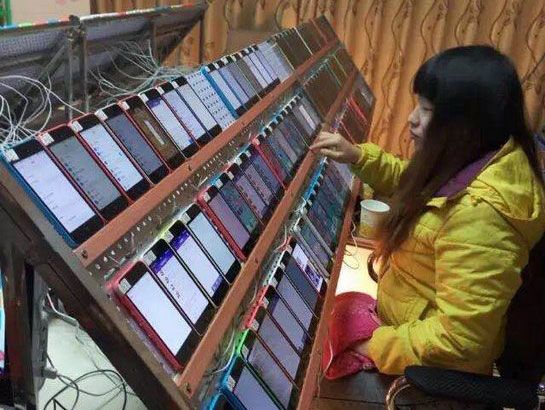
There are also those offering to submit their ain reviews, in-house. In Feb 2015 the prototype in a higher place was posted to Chinese microblogging website Sina Weibo, and is believed to bear witness the rigging of App Shop reviews on a massive scale.
Is Apple tree Doing Enough?
This isn't by any means express to Apple tree'south App Store. Google Play, the Amazon Appstore, the Windows Shop — there are developers and companies taking advantage of every platform, e'er since scoring a big hit meant a large payout. However, Apple is known for its notoriously tough guidelines and $99 developer fee, which prompts the question: how are developers still getting away with it?
Surprisingly, but ane minor point in Apple's lengthy App Store Review Guidelines specifically mentions the manipulation of reviews:
three.ten — Developers who try to manipulate or cheat the user reviews or nautical chart ranking in the App Store with fake or paid reviews, or any other inappropriate methods will be removed from the iOS Developer Plan
This is a rather wide definition, and terms like "manipulation" and "inappropriate" leave a lot of room for interpretation. There's no clear definition about whether bugging users for reviews constantly or gauging user feedback before prompting a review is acceptable. There'due south no difficult limit on how often users can be asked to charge per unit an app, and there's nada stating that incentivizing reviews violates Apple'due south guidelines.
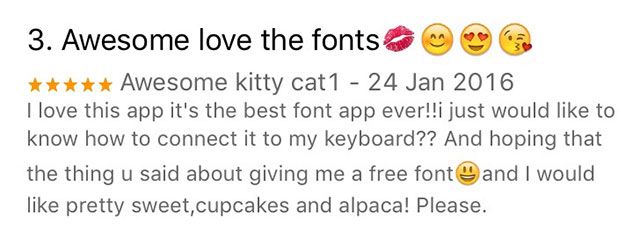
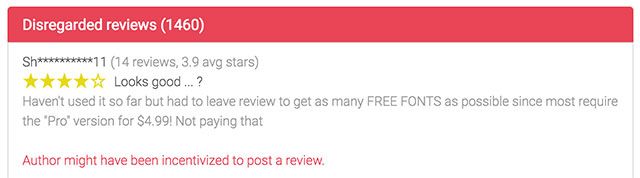
Based on the number of apps that engage in these practices, y'all might assume Apple tree isn't also bothered. The company has however been known to crack down on simulated reviews in the past. In 2014 TechCrunch reported that the company was removing reviews — specifically incentivized reviews — for an app chosen Better Fonts Free which was offering fonts in exchange for reviews.
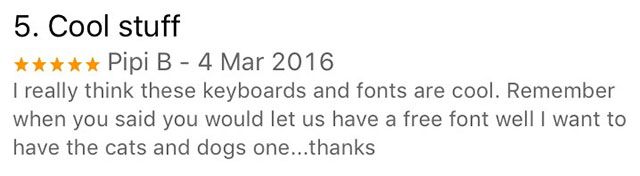
As recently as last calendar week, reviews similar the two above accept been posted, so it seems that non only have the developers not been removed from the iOS Developer Program, they also didn't acquire anything when thousands of their reviews disappeared overnight.
It's not articulate how Apple tree expects the state of affairs to improve if they continue to let developers to violate their own rules, which aren't that well laid out in the beginning place.
Introducing AppRecs
In February 2016 Seattle-based software engineer Mark Edmond of Verdant Labs launched AppRecs, a search engine and review listing site that specialises in spotting fake reviews. The service finds reviews information technology believes are dishonest, then removes them and their overall ratings from the app'due south current score.
Mark's groundwork includes viii years at Amazon, working on (amongst other things) the system through which buyers write reviews, in what he describes equally "a very metrics-heavy culture." Right at present, the service simply works on the App Store, merely "Android is next on the roadmap."
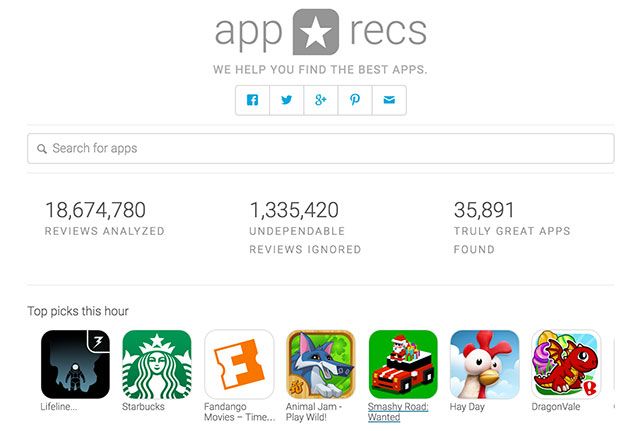
I spoke to Mark and asked him to spill the beans well-nigh exactly how AppRecs decides whether a review is trustworthy or not.
Some are relatively piece of cake to find. If, say, a reviewer has left chiliad reviews, all of them 5 stars, those are very likely to be bogus. If 20 reviewers accept left positive reviews for the exact same 30 apps, those reviews are unreliable also.Some are a bit trickier. If an an app has a high number of reviews saying things forth the lines of "they bribed me to go out a review," the validity of all its reviews is called into question, peculiarly the extremely brusque ones.To take hold of more than sophisticated approaches to gaming the review system, we can expect at a combination of factors. Much like with email spam detection, at that place are occasional false positives, and there undoubtedly are artificial reviews that remain undetected. To address this, the roadmap includes incorporating machine learning. In other words, the computer will detect the criteria for artificial reviews.
AppRecs uses Apple'due south official API, which Marker admits has its limitations. Calculations are limited to the last few hundred contempo reviews, and the service only works for reviews that include text (which ways fake star ratings aren't excluded).
AppRecs and then ranks apps based on their trustworthiness using only what it perceives as 18-carat reviews. It even filters untrustworthy apps entirely, though you can cull to show filtered results when searching if you want to.
Mark also doesn't think Apple is doing much to combat these sketchy reviews.
They're clearly not doing plenty. I've been surprised (and dismayed) at how easy it is to observe apps that blatantly break the rules such as by rewarding users for leaving reviews. I could speculate about reasons for this from, say, a PR, legal, resources, or turn a profit motive standpoint, but ultimately I recall both app users and developers suffer when Apple'southward review guidelines aren't enforced. Users air current upward with lower-quality apps and their expectations not met. Honest developers find themselves on an uneven playing field.
Most "trusted" apps are either paid or quality free apps that back-trail an existing service or are adequately well-known — Slack, Evernote, Amazon Prime Music, and so on. Marking decided to work on AppRecs after finding app discovery ho-hum, and it seems the service has been well-received so far.
Every week, I'grand seeing growth in the number of people using the site, and I'm hopeful that it will remain on its trajectory to cover the data-crunching and hosting costs in the adjacent few months.
AppRecs is using Apple tree'south referral system as a acquirement stream, merely like we practise here at MakeUseOf. Information technology'south not particularly lucrative, but information technology's an honest approach. Mark assured me that work on the Android version is withal inside his sights, with iOS taking priority because "Apple provides APIs for getting the data I need."
What Exercise You lot Remember?
Has it occurred to you that a big number of reviews on the App Store are untrustworthy, incentivized, and even paid for by the developers themselves? Practise you apply Apple's star rating or read reviews when deciding what to try and purchase? Would it exist nice if Apple tree did more to resolve this consequence?
Bank check out AppRecs and let united states know what you call up of the land of reviews on the App Shop beneath.
Almost The Author
larochelleupperfic.blogspot.com
Source: https://www.makeuseof.com/tag/trouble-bad-itunes-app-store-reviews-avoid/
0 Response to "How to Avoid Bad Reviews in App Store"
Postar um comentário